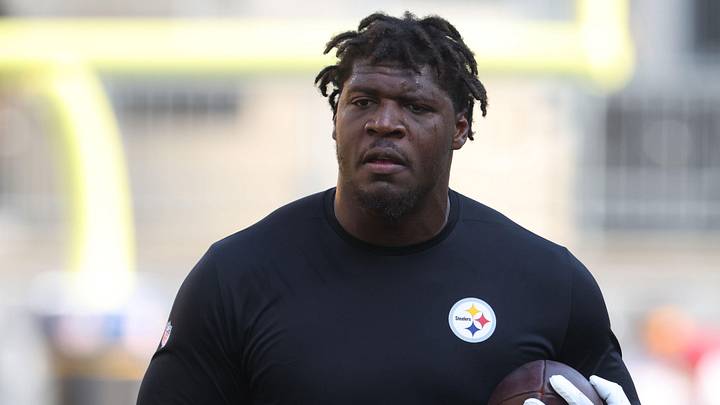
Darnell Washington is impossible to miss on the football field. His massive frame towers over linebackers and safeties; he routinely boxes out in the passing game, and when he’s had the ball in his hands, would-be tacklers don’t want to get in his way. But the Pittsburgh Steelers could face a concerning issue regarding Washington.
To put it frankly, the tight end is getting too big.
At the 2023 NFL Combine, Washington measured in at nearly 6’7” and weighed 264 pounds. However, in November of last season, the Steelers’ tight end admitted to weighing 311 pounds. Now, entering his fourth NFL season, Washington looks bigger than ever — and it’s no longer a good thing.
During the second week of Steelers OTAs, veteran reporter Mark Kaboly posted a short video of Washington going through receiving drills. Even in warm-ups, his enormous frame stood out like a sore thumb.
Big Man Ball — Darnell Washington warming up the legs.
The clip itself isn’t cause for panic — these are just warm-ups, and Washington isn’t going full speed. However, the visual is striking. The 2023 third-round pick appears heavier than at any point in his young career, raising legitimate questions about how his ever-increasing size is impacting his on-field performance.
The Weight Issue: When Bigger Isn’t Better
There’s no denying Washington’s rare physical gifts. With an 83 3/4” wingspan (98th percentile) and a towering presence, he was built to dominate at the tight end position. Yet the Steelers must confront an uncomfortable reality: at his current size, those gifts are being undermined rather than enhanced.
As a tight end, Washington doesn’t need to play in the 300-pound range. Even if he trims down to the 270-280-pound mark, he would still possess overwhelming size and length advantages against edge rushers he’s asked to chip or block. He would remain a formidable “people mover” in the run game — the same role he excelled in at Georgia — while regaining critical athletic traits.
The problem with playing north of 300 pounds is the inevitable tradeoff. Speed, fluidity, and overall movement skills suffer. While Washington remains a long-strider who can eat up ground in a straight line, his lateral agility has visibly declined when playing heavy. This is particularly evident when asked to block in space or create separation as a receiver.
For context, when Washington entered the league, he ran an official 4.64 40-yard dash (77th percentile) and posted an elite 4.08 20-yard shuttle (97th percentile). Those numbers suggested a player with rare athletic upside for his size. Today, he simply doesn’t play anywhere near that level of explosiveness or quickness.
Time for the Steelers to Step In
This isn’t about shaming Washington or questioning his work ethic. The Georgia product is an exceptionally rare football player with immense upside. However, if the plan is to keep him at tight end — and all indications suggest that it is — then continuing to carry this much weight works against his long-term development and effectiveness.
A player of Washington’s caliber should be a more dynamic pass-catching threat and a more versatile blocker. Slimming down would improve his ability to get open against linebackers and safeties, enhance his quickness in space, and allow him to sustain higher-level play over the course of a long season.
The Steelers have a decision to make. They drafted Washington expecting him to become a cornerstone piece of their offense. Letting him balloon toward 310+ pounds risks wasting his rare physical profile. Instead of becoming a matchup nightmare who can both dominate in the run game and threaten defenses down the seam, he risks becoming a specialized, lumbering presence whose elite traits are being blunted by excess size.
Pittsburgh’s coaching staff and front office should have a direct conversation with Washington about his playing weight. The goal shouldn’t be to make him small — that’s impossible and unnecessary — but to optimize his frame for maximum impact at the tight end position.
Darnell Washington has all the tools to be one of the most dominant tight ends in the league. The only thing standing in his way right now might be the scale.
